
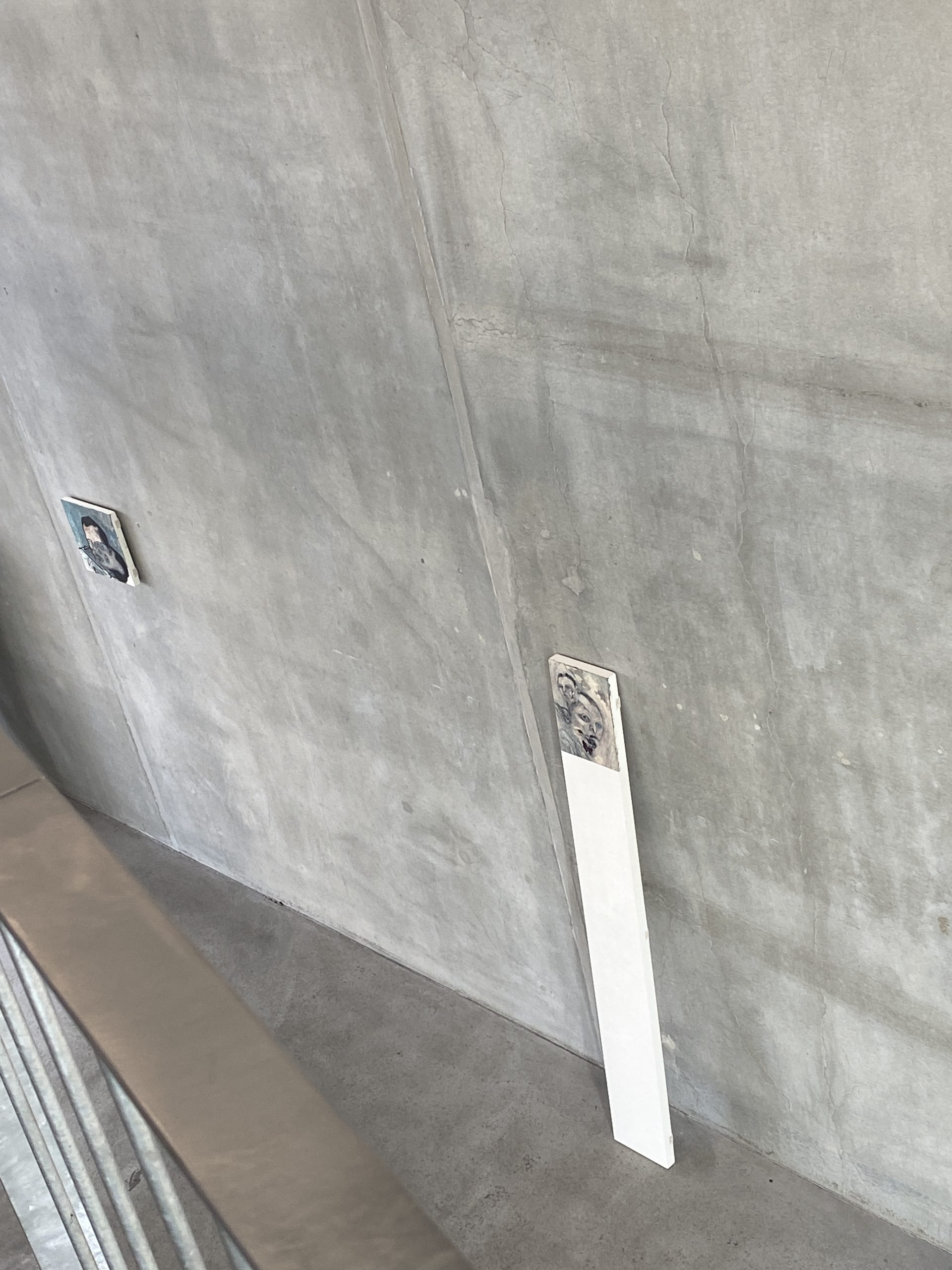
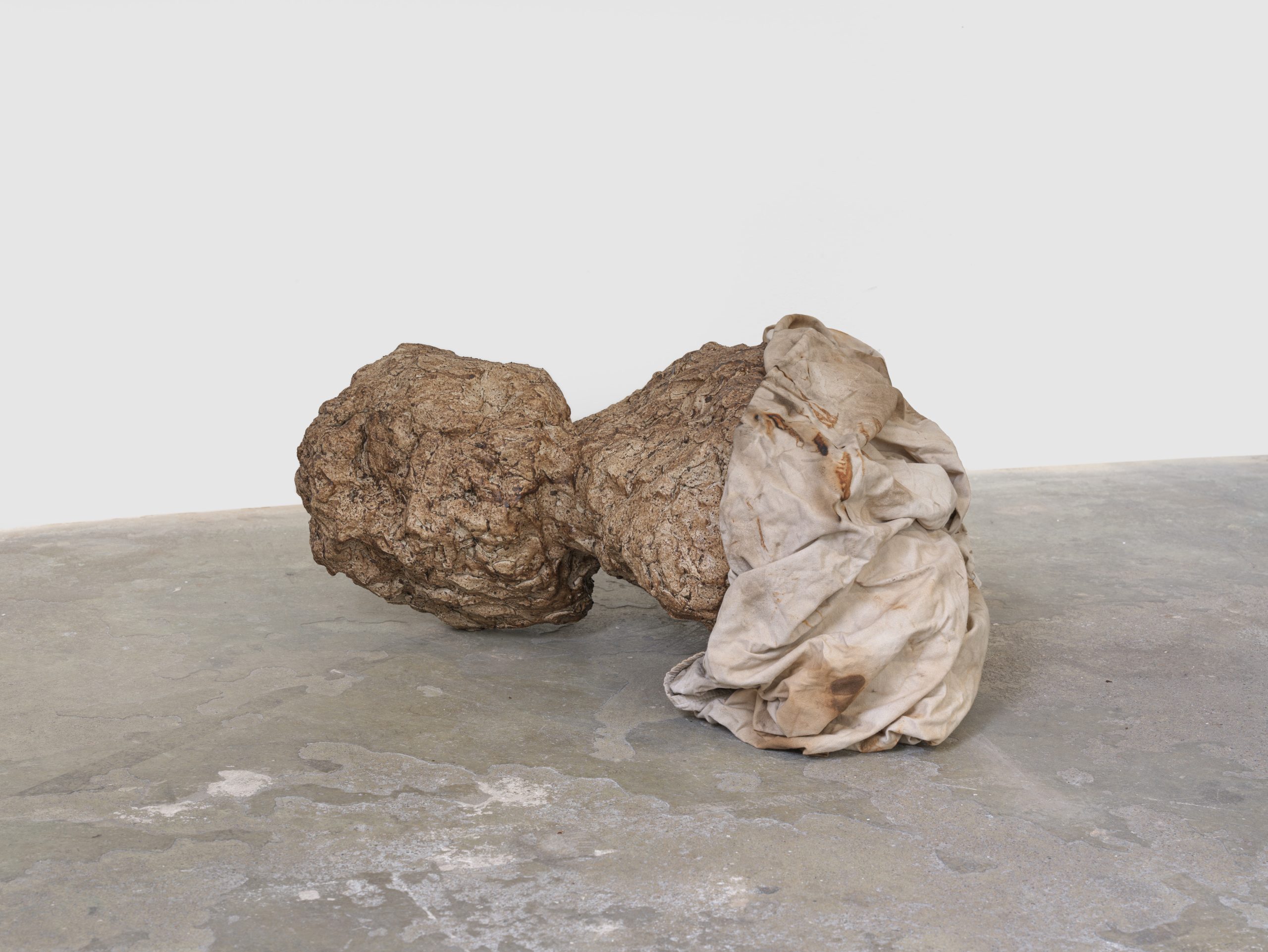
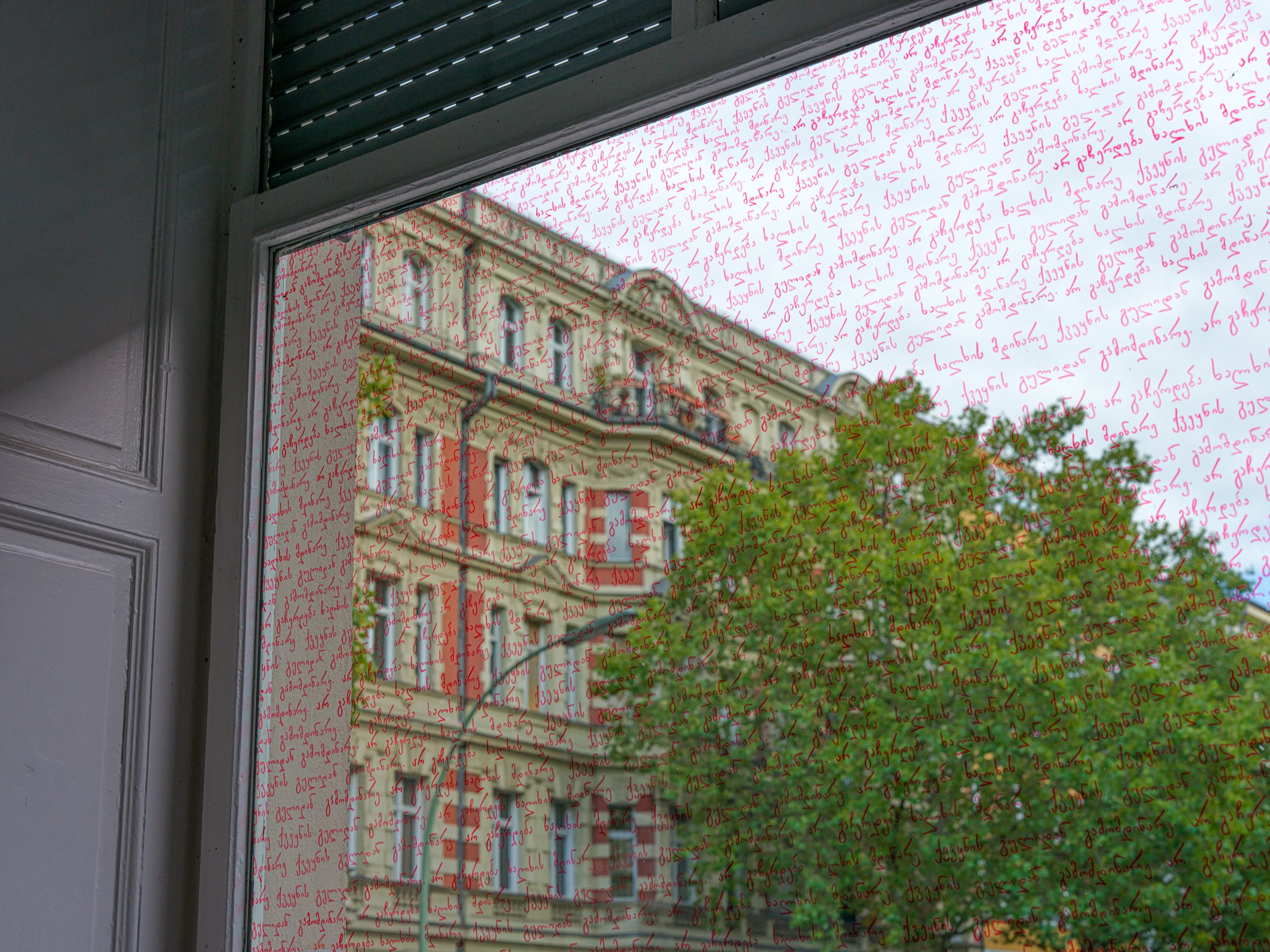
Pic. 1. Zauri Matikashvili. Gallerie Bukia Vakhania. Exhibition view. Pic. 2. Nika Kutateladze. Galerie Molitor. Exhibition view. Pic. 3. Zauri Matikashvili. Gallerie Bukia Vakhania. Exhibition view. Window Installation.
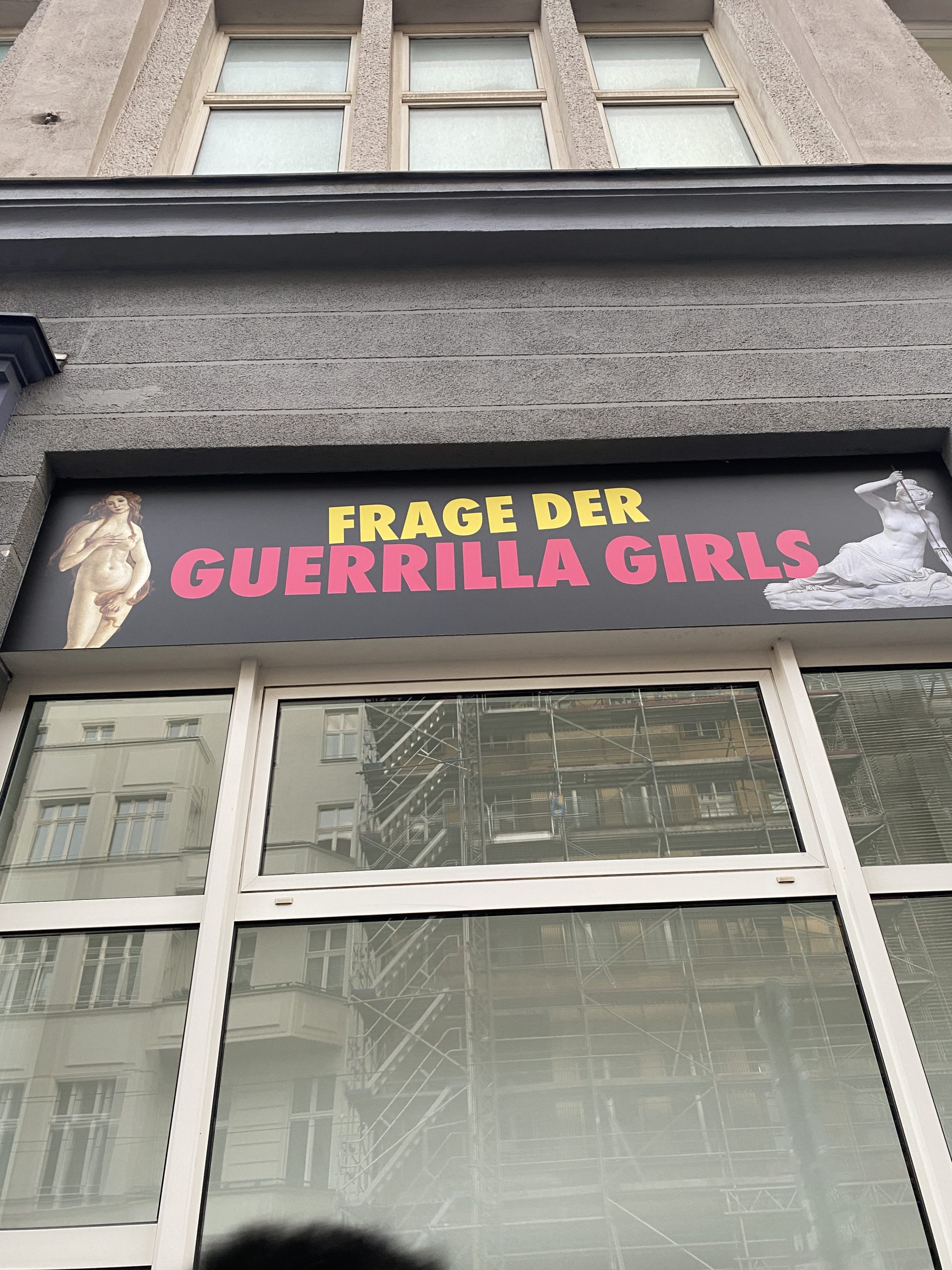
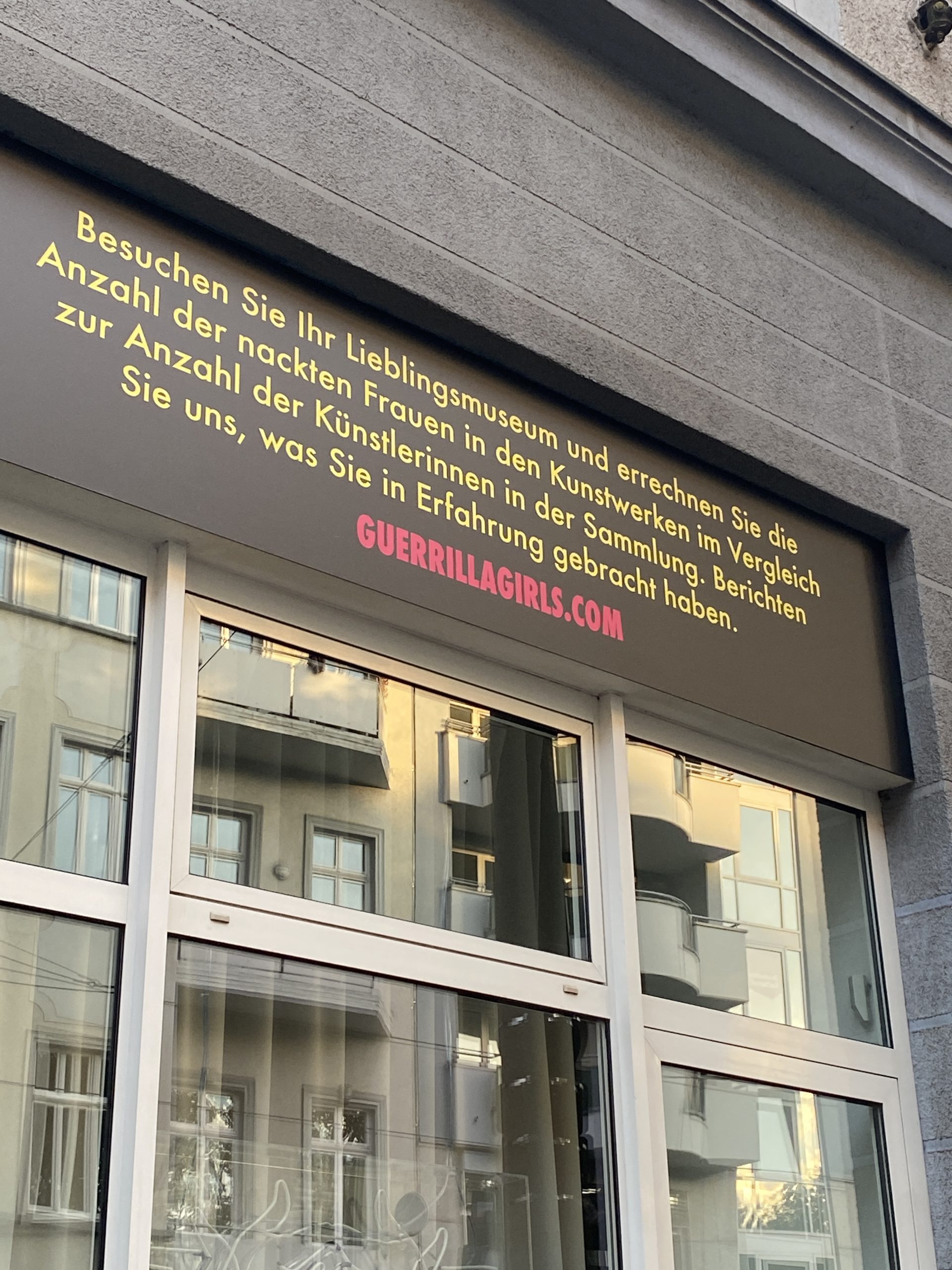
Pic. 4-5. Guerrilla Girls. n.b.k. Facade Installation view. Neuer Berliner Kunstverein
15 Years of Berlin Art Week. Georgian and International Artists Featured in Local Institutions
Text. Dr. Lily Fürstenow
Andrea Fraser’s epic piece ‘Untitled’ from 2003 that was shown at Nagel Draxler Galerie during the Berlin Art Week last year once again underlined the centuries-old analogy between selling art as prostitution. Her highlighting of the role of art commodities in mediating relations of exchange pointed out the intimate entanglement of personal and market valuation, desire and financial exchange that drives the participation of both artists and collectors in the art market and exposed the whole intricacy of emotional economies of desire, belonging and social hierarchies questioning the operating forces behind cultural institutions and motivations of artists, collectors, patrons, gallerists and audiences.
This year Berlin Art Week celebrated its 15h anniversary recapitulating upon its surprising continuity in a city that considers itself the European capital for contemporary arts with an impressive number of international artists, galleries, contemporary art museums, kunsthalles and off-spaces still operating in spite of massive state budget cuts in the arts sector and financial crisis.
In the male-oriented capitalist art markets and art scene male desire and male gaze is a sure thing that dictates tastes therefore the critical approach to the art establishment that lies at the core of the artistic practice of the Guerrilla Girls invited by the n.b.k. (Neuer Berliner Kunstverein) to contribute to the facade of their space at the Chausseestrasse in the Berlin district of Mitte remains as relevant as ever. The essential question, posed by the Guerrilla Girls, is as far as Berlin’s institutions are concerned: Gibt es in Berliner Museen mehr nackte Frauen als Künstlerinnen? (Are in Berlin museums more nudes than women artists? This question installed on the n.b.k. facade addresses the passers by as well as Kunstverein visitors who are herewith invited to go to their favourite museums in Berlin and compare the amount of nudes in the art works to the amount of women artists in the respective collections and send the obtained infos to the guerrillagirls.com.
Throughout their artistic practice Guerrilla Girls remained anonymous assuming the names of the famous deceased women artists e.g. Frida Kahlo or Kathe Kollwitz instead of pushing their own names as brands which is the common practice in the contemporary art world. Their subversive body of work supports art for all in public spaces where it addresses wider audiences rather than elitist circles of collectors, gallerists and art scene crowds. It calls for participatory involvement from all, in this way being radically different from Andrea Fraser’s unique artistic project but close to it in its critical spirit of laying bare the art market mechanisms, secret desires of all involved in their pursuit of prestige, sexual fantasies and self-fulfilment. Guerrilla Girls body of work has been over decades instrumental in disclosing gender and race related injustices within the art world. For the n.b.k. piece in Berlin the Guerrilla Girls studied the motives of nudes in Berlin’s museum collections and made a selection of images that went onto the facade piece including Boticelli’s iconic Venus as an eye-catcher.
Speaking of evils and injustices from historical perspective, coming to terms with the contaminated heritage of colonialism is the main topic of Maya Schweizer’s films at the Schinkel Pavillion. Her work explores ways of how contemporary societies attempt to engage into dialogue with younger generations on the themes of remembrance and interpretation of colonial art. In her work “Autour d’une fresque” monumental mural cycle by Pierre–Henri Ducos de la Haille (1889–1972) in the ceremonial hall of the Palais de la Porte Dorée in Paris (Palace of the Golden Gate) can be understood as an expression of “colonialist realism.” Schweizer’s video Suis son regard et observe / Follow Her Gaze and Observe (2026) examines the mural‘s reception today. The film lives from the dichotomy of various layers superimposed upon one another: e.g. images of the students upon the motives of the frescoes, spoken language upon the formal vocabulary of the motives in the background giving it all a touch of tableau vivant. The young people discussing and making sketches of the colonial frescos are students from Champigny-sur-Marne a small town 16 km away from Paris. Most of the participating students are Africans, their teacher is a white male who guides and encourages the participants to contribute to the discourse – it’s engaging to follow how the discourse drifts as the students comment and voice their opinions about the art work in a conform manner, some feeling uneasy because of the camera, others not even paying attention to its presence.
The whole piece leaves a somewhat ironic bitter feeling since the wrongdoings of colonialism can hardly be undone, and persist, the frescoes dominate the imagery with their vigorous colour palette and obviously all of this is not enough to tackle the complexities of colonial past and its propaganda imagery.
In her second film also presented in the Schinkel Pavillion Schweizer focused on the political propaganda aspects of protests against colonial exhibition policies historically. In her beautifully composed film En parallèle (2026) the artist analyses the protest that accompanied the International Colonial Exhibition right from its opening in Pairs in 1931. It was staged in the purpose–built palace discussed above presenting the works gathered there as showcases of colonialism‘s supposed achievements. In protest against the imperial self–presentation communist activists and Surrealists associated with Luis Aragon organized the anticolonial counter exhibition La vérité sur les colonies (The Truth about the Colonies) and published the boycott call not to visit it.
Here’s the crucial moment (adding some history insights for our unknowing post-Soviet readers) when the Moscow propaganda stepped in offering it exhibition space. The anti-colonialism protest show also took place in Paris in 1931, in the Soviet Pavilion dedicated to the former 1925 Exhibition of Decorative Arts. A carefully selected and masterfully ordered visually captivating montage of letters, exhibition snapshots, citations from correspondence between Moscow regime functionaries, Louis Aragon team and others involved reveals in the film how the cause of protesting colonialism was just a means in the hands of organisers to disseminate communist propaganda of the Soviets even more so since they used the same contaminated visual vocabulary as their counterparts.
Probably due to this critical moment in history that we now experience it’s not a surprise that three Berlin institutions simultaneously but in different ways engage during the Berlin Art Week with the so-called “East” “Osten” focussing on its exhibitions history and the related artists, living or dead: Projektionen auf den Osten at the n.b.k. and Schinkel Pavillion and ifa-Galerie Berlin with its exhibition cycle Rauschen. The size of this review sadly won’t allow to dwell on all the inspiring artistic positions dealing with the “East” shown in the “Projections on the East” curated by Fabian Bechtle and Leon Kahane and accompanied by an extensive programm of discussions and screenings. Yet we can’t help mentioning here briefly a remarkable exhibition mounted by the ifa Berlin dedicated to the exhibition history of the Centre for Art Exhibitions (ZfK) of the GDR.
This show marks the beginning of exhibition series Making Public-on the Work and Legacy of the ZfK in Berlin curated by Susanne Weiß in collaboration with Nadja Abt, Swantje Greve and Petronela Soltesz. Any exhibition lives from the amount and quality of the exhibited artefacts and participating artists. And this one offers a truly impressive and in-depth collection of posters, photographs, exhibition views and even related exhibition and artist catalogues carefully assembled and matched by the curators in the ifa Gallery space turning it into an unexpected detour into the exhibition past of a GDR institution that operated from the 1970-ies till the very fall of the Berlin Wall and was incredibly prolific in its work with 130 exhibitions per year and shows featuring artists from the socialist satellite states, Asia, Palestine, indigenous populations of the Native Americans, and even artists from the former USSR including a couple of Georgian women painters.
The six-part exhibition series Making Public is presented by the ifa – Institut für Auslandsbeziehungen in cooperation with the Wüstenrot Foundation, Schloss Biesdorf, the Kunstverein Ost (KVOST), the Prater Gallery, the Galerie im Turm and is supported by the Hauptstadtkulturfonds. As the ZfK collections were transferred to the ifa in 1991 after its closing down and the same year also Kunsthaus Dresden, was established as the successor institution to the former Dresden branch of the ZfK, the Making Public is promising to be an absolute highlight as it plans to give insights into less discussed part of the so-called made in the “East” part of GDR art history.
A number of new artistic productions – some of which engage with the artists’ own family histories – are part of the dialogue between generations in this exhibition featuring works and loans from a total of more than 50 artists e.g. works by world famous Sigmar Polke and Günther Wecker to artists like Karla Woisnitza, less known outside Germany, who happened to show her Tecuna project in the Frauenmuseum Bonn in 1990 as female artistic networks activated immediately after the vanishing of the iron wall.
The ifa exhibition offers a rich selection of posters, exhibition documentation materials and snapshots of artists, exhibition views as well as of the changing locations of the former ZfK as it travelled from Altes Museum now part of the Staatliche Musen zu Berlin Stiftung Preußischer Kulturbesitz to other spaces in East Berlin. In the exhibition one can trace visual analogies in the omnipresent Soviet-propaganda influenced artistic production of the time immediately recognisable in all media from books covers to graphic design of exhibition posters targeted at a surprisingly diverse palette of potential audiences and introducing cultural heritage and artistic practices from peoples from all over the world.
Cultural influence and propaganda seemed to be the soft tool that the Moscow regime continuously used starting from the 1930-ies as the Schinkel Pavillion exhibition showed throughout all the decades of its existence.
The formal vocabulary and the language of the posters addressing the viewers remained however, like back in the 30-ies, shaped by colonialist terminology – e.g. an exhibition invite that refers to the indigenous North American peoples as “Prärie-Indianer” or an evident imbalance in the presentation of mostly Russian artists in the Soviet travelling exhibitions at the ZfK. Mostly Russian artists on the USSR art catalogue covers, to name but a few. As the USSR consisted of 15 so called republics it’s hard to assume that none of these produced a painter that would be worthy of participating in a prestigious ZfK Berlin show abroad or get a cover on a respectively prestigious art catalogue – all priviledges obviously only for the communist party member Russian artists.
Artistic appropriation was apparently widely used by Soviet artists too back in the 80-ies as is evident from the catalogue cover of the “Junge sowetische Künstler. Malerei und Graphik” with a motive from Nikolai Beljanow’s Reflexion (Detail) 1982 – where the artist goes for visual quotes of famous art works including Niko Pirosmani’s iconic Georgian female motive of “Ortachalian Beauty with a Fan” now part of the permanent collection of the Tbilisi State Art Gallery.
Now that the totalitarian Soviet regime is long gone there are a bit more artists from Georgia represented by galleries across Berlin during the Berlin Art Week throughout the rest of September. Bukia-Vakhania presents works by Zauri Matikashvili. “The Sun Inside and the Sun Outside” is an exceptionally poetic artist created ambience within a gallery space turned into a personal universe for inner reflexion, private memories and subjective visual references. It all revolves about the inner and the outer realms e.g. the hand-made inscription that the artist wrote on the Gallery window pane in pink in Georgian language that looks like a mysterious flowing ornament for all who are not familiar with the Georgia alphabet. Writing marks the space separating street views from the interieour where metal place holders usually used in Georgia to provisionally mark spaces outside e.g. for parking lots or construction sites, symbolise borders and limits- private or public.
With the overthrown bust made of used fabric and materials imitating marble the artist probably refers to the act of throwing off from the pedestal, a rebellious gesture as one approaches the dark room where the artists new video is projected that records the wave of protests in Tbilisi against the current political regime. The protests were recorded last year in various seasons as one sees from the clothes worn by the people and as is obvious from street decorations marking the X-mas times. The demonstrations are filmed outside and how they enter the interieours and inner private lives of people when they watch TV while having a meal at a table. One sees protesters singing peacefully with cell phones in their hands or knocking incessantly at the closed doors in a frantic rhythm wrapped in white-red Georgian flags. The knocking sounds ominously aggressive whereas the massive doors remain locked. The protesters are left outside.
Gallery Molitor in the vicinity of Bukia-Vakhania on Kurfürstenstrasse 143 also features a solo show by a Georgian artist Nika Kutateladze. In his portraits the artist probes the possibilities of how to strip back the surface of a face. He approximates porosity as orifices hollow into a ghostly pallor and contours fracture or dissolve. The monsters that recur throughout this group of paintings show their teeth in a threatening manner. Kutateladze’s work stands in a lineage of portraiture concerned with a darker vision of life and is reminiscent, at moments, of Francis Bacon’s concern with “the whole horror of life, of one thing living off another.” Some of the works are painted on massive white wooden panels leaned against the grey concrete walls. The portraits appear almost lost within the monotonous greyness of the ambience but they never fail to haunt one with their zombie-like distorted grimaces once you come closer.
The portraits are reminiscent of the grotesque ornaments that in past epochs used to be ornamental decorative details with fantastical, distorted, or sometimes humorous grimaces and monster motives adorning pieces of furniture or house facades. Painted on white wood panels the portraits have something in common with decorative elements. Especially since the artist who initially studied architecture and used to work in sculpture and installation apparently treats portraiture as part of the Gesamtkunstwerk integrated into it all. A ramshackle fence of acacia wood in the gallery basement leaned against the walls with paintings refers to the fences in the painter’s native village, as acacia trees are often grown in Georgian countryside simply to provide the wood for fences around land lots.